April 15th, 2008
In the last weeks, there has been a series of relevant discussions about economic policy in Argentina. The reason: the massive lock out of the countryside against the rise of export retentions, particularly in the soybean market. During almost three weeks, groups linked to agricultural exports closed the roads and stopped the passing of trucks carrying grains and, in many cases, milk and other food products, which created an important shortage of food in the cities.
Retentions are taxes collected from the exports of certain products, to provide more resources to the State, but also to lower the impact of the international prices' increase in the local market. Adding to this, since 2002 the Argentinean State insists on a policy of maintaining a high dollar value to make exports competitive. But to keep this exchange rate - that favors farms, industry and tourism, among others- important fiscal resources are needed.
In this context, a type of blog acquired a sudden popularity: those written by economists. Many of us didn't even know they existed, but the need for better information about the conflict between the countryside and the government have turned them into a very good source of information, epecially when facing the poor coverage of the media, plagued with generalizations and common sense statements from both sides.
Homo Economicus [es] is a group blog, but most of the entries are dedicated to the topic of the countryside and were indicated that they were written by Tavos, an economist that prefers to keep a pseudonym. Among its entries, the blog mostly focuses on pointing out the weakness of the arguments of those who favor the countrymen's measures. In an entry called “La rentabilidad del agro” he analyzes how those in the countryside are making even more money than they were in 2007, even with higher retentions. And, inspired in Arturo Jaurteche [es], he analyzed the “nonsense” that was repeated by some people in favor of those who closed the routes.
On the other side, at Economista Serial Crónico [es] they summarized the main reasons by which arguments against the countryside were not well sustained
Los Tres Chiflados [es] is another group blog, but in this case, with higher effective participation. And part of this plurality has become in reading entries where there are very different postures, be it against the countryside [es]
Parece que se creen dueño del país, o por lo menos de las rutas. Los últimos 20 días toda persona perdió la libertad de transitar con lo que quiera y por donde quiera por el país.
It appears that they think they own the country, or at least the roads. During the last 20 days, everyone lost the freedom for free transit with whom they want and wherever they want in the country.
or against the government [es].
Un discurso y una practican política que es la misma que mantiene hoy la Presidenta y que puso en práctica durante esta grave crisis que afecto al país. Una acción que usa a los piqueteros como fuerza de choque violento, y la violencia de las palabras desde el pulpito presidencial para fulminar opositores, disidentes, periodistas y más recientemente, humildes pero prestigiosos artistas como Sabat.
Rhetoric and politics that are the same that the President maintains and puts into practice during this heavy crisis that affected the country. It is an action that uses the “piqueteros” (members of a social movement) as a violent confrontational group and the violence of rhetoric from the presidential pulpit to attack the opposition, dissidents, journalists, and recently, humble, but prestigious artists like Sabat.

Photo by Quique Mendizabal and used under a Creative Commons license.
While the big topic in the last weeks in blogs about economy was the conflict between the countryside and the government on the retentions issue, in many of them there are entries dedicated to specific theoretical matters and other discussions. The overview gives a surprisingly great variety and vitality, so you'll have plenty of options. To list some of them, you can check blogs such as Controversias del Capital [es]; Mide / No Mide [es]; Exabruptos de Miguel Olivera; Ramble Tamble [es]; La ciencia maldita [es]; Abuelo Económico [es]; Trade and Me [es]; Finanzas Públicas [es]; y El lobo estepario [es].
0 comments · »»March 25th, 2008

Photo by Santi Boy and used under a Creative Commons license.
Twitter has been one of the most talked about tools in 2007, and communites have been created around short messages or microblogging. Many were quick to realize its usefulness or its “fashionable” status. In spite of all of this, Twitter remains in use, with more users each day and with hundreds of thousands of messages per day. In that community, the idea to create a network of Argentine web entrepreneurs was born. Santiago Siri commented that it would be interesting to get together because many web 2.0 iniatives in Argentina appear to be based out of Palermo, one of the more traditional neighborhoods of Buenos Aires.
Mariano Amartino of Weblogs Sobre Weblogs [es] summarizes what happened :
A Vanesa Kolodziej, inversora de capital de riesgo, la idea le pareció interesante: junto a otras personas de Twitter tomó la URL, subió un blog y organizó en menos de 3 días la primer Palermo Valley Night: un happy hour para inaugurar el barrio y conocer a las demás personas interesadas en web 2.0. Calcularon que vendrían 20 a 30 personas, pero asistieron más de 70, todas relacionadas con proyectos de Internet locales.
For Vanesa Kolodziej, an investor of risk capital, the idea seemed interesting: along with others from Twitter, the domain name was reserved, a blog was uploaded [es] and in less then 3 days, the first Palermo Valley Night took place: a happy hour to inaugurate the neighborhood and to get to know others interested in web 2.0. They estimated that 20-30 people would attend, but more than 70 showed up, all of whom were involved with local internet projects.
Palermo Valley became a regular gathering of local entrepreneurs due to the excellent response to the invitation on February 21. They opened their blog very quickly, where the event was recapped and a list of blogs that mentioned the gathering [es]. Psicogeek [es] summarized it this way:
Hoy estuve un rato en el primer encuentro de Palermo Valley, fue impresionante ver la cantidad de gente que se acerco en una convocatoria por medio de Blogs y Twitter. El bar donde nos juntamos quedo completamente desbordado ya que como mucho entraban 25 personas sentadas y fueron más de 70!!!!
Today I was at the first gathering of Palermo Valley. It was impressive to see the amount of people that attended due to the invitation through blogs and twitter. The bar where we gathered was overflowing because it can easily set 25 people, but there were more than 70!!!!
The event's objective was to create a space for networking among local entrepreneurs that launch projects, which do not have many resources to promote them. In addition, these entrepreneurs gather with another objective: network with potential investors. Due to the success of the event, some of the organizers launched a parallel event called StartMeUp Argentina [es], which they define in this manner:
Start Me Up Argentina es un punto de encuentro real para que quienes están creando startups online se conozcan y creen la próxima generación de empresas web 2.0. Argentinas, a través de eventos a lo largo del año.
Start Me Up Argentina is a real-life gathering place for those who are creating online start-up companies, so that they can get to know one another and creat the next generation of web 2.0 companies from Argentina through these events this year.
On March 13, the second gathering of Palermo Valley took place. The first gathered 70 people, this time more than 300 were in attendance and the listing of web projects grew rapidly. The blog of Uptuu [es] summarized that night:
Godoy (el bar seleccionado para el evento) alojó a unas 300 personas y si bien en un momento la barra fue un poco sobrepasada, en líneas generales fue un muy buen lugar el elegido. Mucha más gente que el anterior muestra dos cosas; una, que hay mucha gente trabajando en la Web; y la segunda, es que muchos “curiosos” que quieren empezar en el mundo de los negocios Web usan estos eventos para hacer algunas consultas, las cuales -a pesar de no ser los mas experimentados- respondimos y esperamos haber ayudado.
Godoy (the bar selected for the event) attracted some 300 people and the bar was a little too full, but in general it was a good choice. The fact that there were more people than the last time showed two things: one, there are a lot of people working with the Web; and the second, that there are many other “curious” who want to start with these online businesses that use these events to ask questions, of which - even though we are not the most experienced - we respond and hope that our answers helped.
The third edition of Palermo Valley is currently in the works [es] where some of the projects will be presented for this gathering. The Argentine example has motivated other Latin American countries to hold their own “Valley gatherings.” [es] As detailed on the blog of Palermo Valley, there are already Costa Rica Valley [es] and in Chile, Santiago Valley [es] and Salmon Valei [es].
If you want to see the complete list of the startups and the sites that participate in Palermo Valley, visit the entrepreneur blog. There are also photos on Flickr and on an account at Linkedin.
Translation by Eduardo Ávila
1 comment · »»February 29th, 2008
In Argentina, the proposal of the Member of the Parliament from the official party, Claudio Morgado, is called “New Law for Music”. Article 21 of the new proposal states:
To create the Culture Development Fund, which will be under the administration of an entity formed by the National Institute of Music, National Institute of Film and Audiovisual arts, National Theater Institute and entities of collective management. The fund will be created by the sum amount collected by the implementation of a direct tax to every object that permits the storage, recording and reproduction of music and images.
In a very quick fashion, many Argentinean blogs started to cover the topic. The proposal was very similar to the direct tax that today is applied in Spain, and by which any media that allows to store or copy the contents must pay a percentage of its value as a “compensation” to the creators of works with copyrights. It is, in theory, a form to fight “piracy” and the loss of income by musicians, discographies and institutions that collect copyrights.In his blog, Denken Uber [es], Mariano Amartino thinks otherwise:
Bienvenida la idea de que ahora la piratería va a estar protegida legalmente porque, si me cobran un impuesto para “compensar, de alguna manera, los derechos intelectuales (fonográfico, de producción,etc,) de los autores, quienes se verían perjudicados por las reproducciones impagas de sus obras” esto implica que tengo el DERECHO de reproducir sus obras porque el cánon es la compensación que ellos reclaman.
Welcome the idea that now piracy will be legally protected because, if I pay a direct tax to ‘compensate, somehow, the intellectual rights (photographic, production, etc.) of the authors, who would be affected by unpaid reproductions of their work' this means that I have the RIGHT to reproduce their work because the tax is the compensation they claim.
There's also a page about this topic, No al canon [es], administered by Fabio Baccaglioni, from Fabio.com.ar [es]. There's a compilation of resources on the topic, and also a list of a large number of entries and articles published in blogs and newspapers. The repercussion of this topic in the Internet was such, that the M.P. Morgado called a meeting, where he invited many bloggers and journalists.According to Vanina Berghella, from La Propaladora [es], in that meeting “Morgado said he was against the payment of a tax that increases the price of digital objects” and he stated that such proposal had been added to the law project after the suggestion of the Independent Musicians Union as a strategy to finance a “Institute of Music”.Also, Mariano Amartino and Fabio Baccaglioni summarized what happened in the meeting. The famous Article 21 disappeared from the proposal, without notice. But Amartino stated that the discussion about the tax had not been abandoned and that organizations that collect copyrights in Argentina and discographies plan to introduce the direct tax in a future law. For now, the project to implement a canon in Argentina seems to be halted. It's not a minor fact: in a country where buying any kind of hardware or information storage device is expensive, the implementation of this tax would have added more costs. It also would transfer to the whole society the obligation to maintain the discographies business and institutions that collect copyrights. The case of discographies it's particularly interesting: the victims of terrible business decisions in regards to to the Internet, instead of assuming their mistakes and understanding that times have changed, are trying to preserve the model, at the expense of those who buy technology. For those who want to know more about the topic, there's a long list of links at No al Canon.
2 comments · »»December 12th, 2007
Last Friday in Buenos Aires, the Personal Fest was held, which was an event that gathers Argentine and foreign musical artists, sponsored by a local mobile telephone company: Personal owned by Telecom Italy. The show was preceded by an impressive advertising campaign in every imaginable media: television, radio, magazines and newspapers. But this Friday something unexpected happened: during the wait for Snoop Dogg's show, a person was stabbed and another one was attacked, which caused a huge disturbance. Many people ran way causing a stampede and many were trampled on and injured, not too seriously, fortunately. Many of the people who went to the Personal Fest affirmed that it was a miracle that the incident did not end in a massacre. Scared by this incide, and despite there still were a few more show left, many people decided to leave the place where the festival was taking place.
The most shocking fact was that, despite the existence of injured people, practically no media covered the incidents, not even the local cable news stations, who are prone to those “last minute” newsflashes. This particular silence towards a serious issue in an event sponsored by one of the largest advertisers in Argentina, started a real furious reaction among blogs and forums. In a certain way, the fact itself was left in the background, and the big subject was the notorious hiding that the media made of the facts. And when they did bring it up, they did so in a casual way, playing down its importance.
Just a few minutes later, people who attened the Personal Fest started leaving comments on the event's blog, which were deleted a few hours later, something that was reported in blogs such as Personal Fest Desastre [es], a site created to tell the story. The site's creator wrote:
Creé este blog para postear todos los comentarios que fueron borrados del site oficial del Personal Fest. La intención de esta via es canalizar las opiniones q fueron suprimidas del site para garantizar nuestro derecho de expresarnos y defendernos del abuso permanente.
I created this blog to post all of the comments that were erased from the official site of Personal Fest. The purpose of this medium is to channel the opinions that were withheld from the site in order to guarantee our right to express ourselves and defend ourselves from permanent abuse.
In this same blog, one can see pictures of the incidents and a video filmed a few minutes after the stampede of people.
But many other personal blogs also talked about this incident. The journalist Eduardo Fabregat, from Pagina /12, the only news media that informed about these issues, made an early summary report on his blog Pan y Circo [es].
Anoche, en la primera fecha del Personal Fest y poco antes del show de Snoop Dogg, hubo un herido de arma blanca. Según me contó el periodista Roque Casciero (quien confirmó la versión con personal de Cruz Roja y la Policía), desde que trascendió la noticia hubo un importante operativo de Popart y Personal sobre la prensa para minimizar el hecho, e incluso se dio a conocer un comunicado bastante livianito en el que se habla de “un incidente entre un reducido grupo de gente”, no se menciona el arma blanca ni que el herido fue operado en el Hospital Rivadavia.
Last night, on the first night of Personal Fest and a little bit after the show of Snoop Dogg, there was a person wounded with a weapon. According to the journalist Roaque Casciero (who confirmed the story with personnel from the Red Cross and the Police), from the time that the news was announced there was an important operation from Popart and Person regarding the press in order to minimize the event, and even there was a light communication in which they referred to a “an incident between a small group of people,” and there was no mention of neither a weapon, nor the wounded that was operated on at the Hospital Rivadavia.
Also the 20 Palabras [es] news site published about the incident, and hundreds of comments broadened the information.
La desorganización del festival acaba de dejar un herido. Es un chico que acuchillaron en medio de una estampida, tras la que se fue un cuarto del público. Está internado en el Hospital Rivadavia.
The festival's disorganization left one wounded. It is a male that was knived in the middle of a stampede, and after which more than a fourth of the public left. He is admitted at the Hospital Rivadavia.
The website of Argentine version of the Rolling Stone magazine published a light account of the event, which they called “a party”. In this note, comments were disabled. Instead readers literally assaulted the previous article about the show the band The Police played a few days earlier. That article did allow comments and the readers accused the media of hiding the facts. Such comments were deleted, but the magazine published a note about the incident, which can be found here, and where one can find more comments of angry readers.
Behind these, dozens of blogs started publishing about this subject and linking other sites. In a few hours, any person that wanted to find information about the incidents in the Personal Fest could do so. Despite the fact that the mass media had not informed about the issue, the information was widely available.
And there are some early conclusions from different bloggers. The first one, it's increasingly evident that, for certain issues, the traditional media do not monopolize the spreading of certain topics of public agenda, but they still act like they can –in this case, by not informing about a serious incident in an event sponsored by one of the largest advertisers in the country. Unblogged.net [es] writes:
Periodismo ciudadano? La revolución de los blogs? Llámenlo como quieran. Lo que es seguro es que para estar bien informado, con los medios tradicionales, no alcanza.
Citizen journalism? Blog revolution? Call it what you want. I assure you that to be well informed, the traditional media is not enough.
Second, the fact became a real public relations disaster to those who organized the event. Many blogs revealed that the organizing company and the press agency that managed the event pressured to avoid the release of further details of the incidents; by doing this, they created a massive protest in the Net, and now the events have blown out of proportions, as Fabregat of Pan y Circo [es] reported.
Third, that in a country still sensitive for the tragedy of Cromañon, where 194 young people died of asphyxia in a rock concert, any incident in a public event quickly becomes big news. There are no deaths in this case, but there were injured people. Gabby Aloe of La Vie en Rose [es] was relieved that there were no deaths:
Gracias a Dios fue en un lugar abierto y amplio como el Club Ciudad, si era en otro predio con accesos más chico, hoy los estaban contando. La gente corría y decía, “no sé explotó el escenario, explotó el escenario.”
Thank God it was in a large and open space like Club Ciudad, if it was in another location with smaller access points, maybe I would be saying something else. The people ran saying, “I don't know, the stage exploded, the stage exploded.”
Fourth, that the mass media are also one of the most affected parties in this incident; certain agencies cannot control like they used to four or five years ago.Here's a list of blogs that talk about this topic and that have not been cited in the rest of this note:
2 Papiros
Denken Uber
Manzana que no
Vida Vacía
Geekotic
Online
Tecnicalia
La tuya está
Kill Your Kids
Fabio.com.ar
Partido Pirata Argentino
Bonzo
Unos cuantos piquetitos
Pablo Mancini
Bloc de Periodista
Martín Revert
Mundo Perverso
Yo opino que
Sonoaxis
La verdad de la milanesa
If there's a blog I did not mention, leave the link in the comments area.
11 comments · »»October 31st, 2007
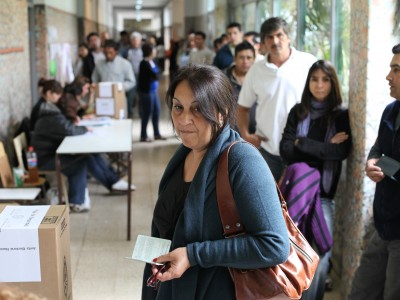
The recent elections in Argentina are over. Some say that these elections have probably been received with the most amount of apathy since the return to democracy in 1983. A couple of days before the elections, there was almost no sign of them in the streets, except a few posters. Most citizens did not take active part in the process, but that doesn't mean there were no repercussions afterwards. In fact, the topic was tackled by many local blogs.
Controversy was not absent. Many blogs posted strong criticism against Nestor Kirchner's government and against his successor, Cristina Kirchner. If you take into consideration that the officialism's victory was quite solid, with almost 45% of the votes, such critics attract attention. If one take into account that the places where Cristina got less votes were the big urban areas, where most of these bloggers are located, one may understand this particular dissociation between the results of the election and these bloggers' opinions.
Just by checking Twitter while the results of the poll were being released, one could find that most of the reactions, in general, were a condemnation of the victory of the current government party. Even blogs that promoted not to vote Cristina, such as No voto a Cristina [ES] (I don't vote for Cristina), were created. Of course, from the side of the officialism, there was also a use of Web tools as you can see in Sumate a Cristina [ES] (Join Cristina), with pictures in Flickr, Twitter news updates and even supporter assistance through MSN Messenger.
And if before the elections nothing much happened, the day of the poll was quite rocky. There were reports that the polling places opened late due to the lack of election officials. There were long waits to be able to vote, many parties' ballots were missing, none of the government's though. Many political parties weren't even able to place observers at many polling places. After the election, it becomes clear that voting methods will have to be revised for the next time.
To see some of the critics and the level of aggressiveness of some opinions, check the comments at this entry: “El show de Cristina” at eBlog [ES]. There were opinions, from those against the government, that talked about fraud, government employees that stole, and being God's will at the results of the polls.
On the other side, there were the people who accused bloggers and participants of not understanding what was going on, and said that “Cristina's voters don't use Nokia n73 or have blogs”. This level of division is something to be concerned about in regards of the future of Argentina, but at the same it's a characteristic of any debate in Argentina where representations of Peronism and it's meaning for the local political life takes place.
Some interesting entries to see the local debate about the elections:
Al final son todos iguales (At the end, they're all the same): at Fresco y Batata [ES]. Italo Daffra criticizes the ideas of the future president:
la electa presidenta de la Argentina dijo la semana pasada que el periodismo no debe publicar temas que perjudiquen la imagen del país. Lo que sorprende de esa frase es la similitud con lo que propugnaba la última dictadura, que ejercía la censura basado en que se quería dañar la imagen de la Argentina. Tan diferentes, tan parecidos.
The President-elect of Argentina said last week that journalism should not publish topics that hurt the country's image. What surprises me is the similarity with what the last dictatorship said, that practiced censorship based on what wanted to hurt Argentina's image. So different, so similar.
La gran revelación de Morales Solá (The great revelation of Morales Sola): Darío Gallo, from Bloc de Periodista [ES], and a very ironic and controverted post about the state of Cristina Kirchner's neck, which had been noticed to be Photo-shopped in pictures.
El error de Carrió (The mistake of Carrio): Juan Tapiola points out what he believes are the mistakes in the political positioning of Elisa Carrio, the candidate of the Coalicion Civica, who got the second place in the elections.
Creo que Carrió ha cometido un error estratégico básico. Elisa se ha posicionado en el ciudadano argentino como la opción de la ética y la honestidad. Muchos años de denuncias públicas y una conducta impecable le han capitalizado en Carrió este posicionamiento tan fuerte en Argentina…Sin embargo el posicionamiento de Elisa es el de una idealista y no necesariamente el de una gestora. Y aquí es donde creo que ha cometido el error… Pero la gestión y el día a día la debería haber delegado a un personaje con una fuerte imagen de liderazgo en el ámbito de la administración
I think Carrió committed a basic strategic error. Elisa positioned herself to the Argentine people as the choice for ethics and honesty. After many years of public complaints and impeccable conduct, placed Carrió in a strong position in Argentina. However, Elisa's place is as an idealist and not necessarily as an administrator. This is where I think she made her mistake… The administration and daily management should have been delegated with a person with an image of a strong leader in regards to administration.
Jodete: about the lack of ballots in the elections, a topic of much institutional seriousness, and one that raised all kinds of comments.
El gobierno que elegimos (The government we chose): provides criticism of the results, where many of the legal scandals this government had been noticed.
La Nueva 2º Fuerza, la CC (The New 2° Force, the CC): a blog of Elisa Carrio supporters analyzes the results.
Preguntas sin respuesta (Questions without answer): at Uno más del montón [ES] they wonder about the legitimacy of the results, since there were so many complaints about problems at the time to vote.
At Sumate a Cristina [ES] (Join Cristina) there's a list of blogs that support the candidacy of Cristina Kirchner, although unfortunately many of them have not updated after the elections.
1 comment · »»August 6th, 2007
Mine exploitation in Argentina has been controversial for decades. While this kind of activity is presented as economically positive, many populations strongly oppose it due to its environmental impact. In many cases, the start of mining projects in the region has raised reasonable suspicion of connivance between the local political power and transnational companies. In these negotiations, the possibility of large profits was quite an incentive to ignore the will of local populations that oppose these kinds of economic activities. Since 2003, the blog Oro Sucio [ES] follows the topic of mine exploitation and its political and environmental impact. Luis Claps, who maintains the blog, is also the spanish Editor of Mines & Communities Network. He has a degree in Communications Sciences from the Universidad de Buenos Aires. He's part of the Asamblea Patagonica contra la Contaminacion y el Saqueo (Patagonic Assembly against Pollution and Plunder), the Union de Asambleas Ciudadanas (UAC) and the Observatorio Latinoamericano de Conflictos Mineros (Latin American Mining Conflicts Observatory), and has participated in many forums and reunions of communities affected by the mining industry in Argentina, Chile, Bolivia, Peru and Equator. He lives in the patagonic region of Puerto Madryn, Chubut province, Argentina.
In this recent interview, Claps discusses his interest in this field and how his blog draws attention to the impacts of mining.
Global Voices: How, where, and when did you come up with the project? What reasons triggered the interest in working with this topic?
Luis Claps: Oro Sucio was created in the middle of 2003. We'd been closely following the struggle of Esquel against the Canadian mining company, Meridian Gold. We had been working on our thesis for the communications degree at the University of Buenos Aires. The topic was precisely on this case, so we had a lot of material. We decided to make use of this material, publish it, and somehow fill part of the hole that the local and national press left in regards to the this mining issue. We perceived there was good work there and that it was a space where we could be useful as advanced communications students and future professionals.
GV: In the blog there are several articles by many authors and from many locations in Argentina. How do you contact them or organize this coverage?
LC: To attempt to provide full coverage of all the mining conflicts is almost impossible. We make a quite heterogeneous and sporadic selection of material, since the site doesn't update on a determined regular basis, but rather whenever we can. We publish documents that are the result of collective fieldwork. Also, we keep in contact with many people and organizations that work in this problem in Argentina and other countries as well. Of all the amount of information around, we try to ultimately publish the least visible cases, and what we feel needs our support. And also, every now and then, some informs of our own or from trustworthy colleagues.
GV: The topic of mining usually leads to important mobilizations in many Argentinean locations, but these are poorly covered by the big media. What do you think are the causes?
LC: We believe the causes are diverse, and that each case has a particular mix of circumstances. There's a big dependence on official advertising guidelines, especially in the regional media, and this discourages a deeper coverage. There's a logic in the journalistic activity that forces the press to constantly jump from one topic to the other. There's straightforward censorship and strong pressure, in many cases. But there's more: the Venezuelan mogul Gustavo Cisneros (owner of Caracol Television, I-Sat, Space, Radio Disney, just to mention a few media) is part of the Barrick Gold Corporation's board of directors, one of the world's most powerful mining companies. So, there's many issues. But the assemblies and popular movements know all of this perfectly, and they go out to manage their own press coverage and intervene in the media's agenda. And they do it quite well. There are moments when the collectively accumulated information (in an autonomous, patient, word-of-mouth kind of way) reaches a level where it's no longer possible to restrain, not even by the big media. When this happens, even the politicians assume a speech that adjusts to the community's arguments, and they try to capitalize or domesticate the problem. On the other side, there are colleagues that work by advising mining companies to develop “crisis management” strategies.
GV: One of the most present topics in mine exploitation is the relation between political power and the companies. Could you cite cases in which the people's mobilization and the media coverage definitely stopped projects that would've affected the environment?
LC: For communities potentially affected by mining projects, there are only partial victories, there are no definite triumphs. In our country, there were very important advances: in Esquel the Meridian Gold project was stopped; in Ingeniero Jacobacci, it was the Calcatreu project from Aquiline Resources; in Mendoza, a law that prohibits the use of toxics in open sky mining was recently approved; in La Rioja, Barrick Gold announced that it's leaving Cordon del Farnatina because a similar law that was approved and the neighbors had cut the access route to the project for over four months!
In these cases, there was a lot of work from all available fronts: communication media, legal actions, public manifestations, legal modifications, etc. But Meridian Gold still has its office in Esquel, and last year, it started taking legal actions against four neighbors and two local journalists. Aquiline Resources continues exploration works in the south line of Rion Negro, while it tries to “modify the province's political conditions” (as we read in the press releases from Toronto), and as if something was missing, Carlos Menem is a candidate for governor in La Rioja, with some possibilities to win the elections next August. So, unfortunately, the threats are still there. Just like political power, capital also recycles, changes faces, returns, straightens, and goes straight to the attack.
GV: What are the topics that are most covered in Oro Sucio, by specific problems or location?
LC: We cover a little what happens in the Patagonia, which is our area. And mostly it's two lines: resistance to mining project and the mining companies' strategies facing this resistance. We understand that mining mega projects operate on many different levels: political, legal, social, environmental, and economic. We try to identify the particular aspect on these levels, in the framework of a more general or global outlok. Another issue that interests us is the connection of the different experiences of the struggle, many of which involves the company itself: for instance, Barrick Gold operates in San Juan and La Rioja (Argentina), Valles del Huasco (Chile), Ancash (and other regions in Peru), Nueva Gales del Sur (Australia), Marinduque (Philippines), USA, Tanzania, Papua Nueva Guinea… How can information be exchanged in solidarity among those affected around the world?
GV: Could you mention other sites that cover similar problems?
LC: Yes, there are many other sites. In spanish: the one from the Asamblea de Vecinos Autoconvocados por el NO A LA MINA de Esquel [ES] and the Coordinadora de Asambleas Ciudadanos por la Vida de La Rioja [ES]. There are sites for specific campaigns such as No a Pascua Lama [ES] or the global protest against Barrick. You can also check the site of the Observatorio Latinoamericano de Conflictos Mineros [ES], the Confederación de Comunidades del Perú Afectadas por la Minería [ES], or the OLCA de Chile [ES]. The DECOIN [ES] site covers the long conflict between Íntag's communities and the Canadian company Ascendant Copper in Ecuador. In the English language, there's the Mines and Communities Website, and many sites of organizations such as Mining Watch Canada.
2 comments · »»May 1st, 2007
In the last few weeks, a series of protests by teacher unions from the Argentinean Patagonian provinces has been all over the news. In particular, this attention was even bigger after the murder of Carlos Fuentealba, a teacher that participated in a protest on one of the routes. The one responsible for the crime was a member of Neuquen's police department, who was in that location because of governor Jorge Sobich's order to dislodge the route and repress everyone on it. The seriousness of the events not only mobilized the traditional media, but also many blogs started to cover the events. An outstanding blog in this coverage is Pensamientos Despeinados [ES], a collective blog maintained by Ezequiel Apesteguia, Nicolás Malpede and Seba Espiño. Apesteguia answered our questions about the coverage. You'll find some links to the Pensamientos Despeinados entries related to the Neuquen conflict at the end of the text.
What led you to cover the Neuquen conflict?
Ezequiel Apesteguia: There were three things. First, the event itself, the murder of Carlos Fuentealba, which was not the first one in this province due to police repression in popular protests. Second, the need of non-filtered information of everything that was happening in our city, because even though national coverage was huge, we felt that there lacked the local view that big media can't supply. Third, the practice and experience for us, as journalism students and the possibility to experience different narrative forms that blogs, in this sense, provide.
What means did you use for this coverage?
EA: We got up early, took the bus and kept walking around, watching and snooping around everywhere. We took a digital camera, a recorder, pen and paper.
Did you get help from readers or spontaneous collaborations?
EA: We always try to encourage collaboration in the blog and we enjoy it. In fact, the first post [ES] about what happened came from a friend, el Chino, who sent us an email with the post for us to publish. Anyways, the biggest participation came after the publication of pictures and videos: they started leaving comments, sending mails with opinions, suggestions and everyday stories.
Did other blogs or sites cover the facts as you did?
EA: One of the problems we have in the region is that there are few blogs -just check Argenblogs to get an idea- and, therefore, we do not have as many possibilities to provide evenly distributed or collaborative coverage. Anyways, many of the blogs mentioned the story, even when they were not there. I think the best coverage of the events, at a digital level, was 8300 [ES]. In fact, 8300′ s site was closed for modifications and they placed it back online just to inform what was going on. I thought it was great they did that.
How did you find the local or national media coverage?
EA: The unfolding of the national media was amazing, with their anchormen and satellite antennas invading everything. They did a complete job, transmitting 24 hours, but they lacked the local view to contextualize the information, which is something they always lack. Locally, the problem is that the media are too centralized in political power, which undoubtedly becomes an obstacle when it comes to informing. I think the best information came from alternative media such as the radio de la Universidad [ES]and the 8300 [ES] site. On paper, the best coverage was the Rio Negro newspaper [ES], which crudely showed the information. The rest of the media, and mainly local tv, stayed a step behind in the analysis and were way too cautious in the most critical moment of the situation. They didn't contribute at all.
In the future, do you think this kind of news coverage will become more common?
EA: Something that grabbed our attention was that our small coverage was transformed into a novelty -not to say news- in itself, leaving behind what really matters: the information. In the world we live in, that three journalism students from the country's provinces would do something like this for “the sake of art” seems strange. Therefore all the attention is on us, the interviews like this, the references and notes on our work in the big media. For us it's an acknowledgment and a personal satisfaction, but I think it shouldn't go past that (that's why in the blog we don't talk or leave links about these issues). We have to think of these kinds of citizen coverage as something more common, that is not so isolated. The blogosphere in general is doing so, and also the citizen media. These kinds of news coverage will not only become more common, but will also improve. And it's not only about competing with the media, but about participating actively, as citizens, in the construction of reality.
What do these coverage have that the traditional media doesn't?
EA: Unlike the traditional media, we were there, first, as citizens supporting the mobilization and it's cause, and second, as journalists. I think this gives the information a value that goes beyond the commercial, a social value that is priceless.
Links at Pensamientos Despeinados about the conflict in Neuquen:
¿Lo que opina la gente en Neuquén? [ES]
Mi Argentina llora por Carlos Fuentealba [ES]
Movilización, dolor y repudio en Neuquén [ES]
Siguen las marchas en Neuquén [ES]
En memoria de Carlos Fuentealba [ES]
Así vivieron la semana los diarios regionales [ES]
La mañana, momento a momento [ES]
La historia se vuelve a repetir para mal [ES]
April 13th, 2007
One of the most pressing issues of Latin America's education system is the teacher's poor training in the use of new technology, particularly those related to computers and the Internet. It's not uncommon to find cases in which the students know more about PCs than their teachers. So, the creation of Redes Escolares (scholar networks) is quite good news. The site gathers blogs maintained by teachers from Buenos Aires schools, and they're managed with Feevy. In the blog of Buenos Aires' High Schools, they present the project like this:
Redes Escolares is a multi-thematic site co-produced by teachers and schools around Buenos Aires. Managed by the Red de Escuelas Medias (High School Network), it's a difussion tool of the experiences in innovation that tries to show the threads of the city's education network. It works by hosting the schools' blogs, classes and teachers participating in the project and updates permanently, when the different nodes distributed by Buenos Aires generate new content. Today it has over thirty blogs and we encourage the educational community to send those they consider shouldn't be left out of an experience of these characteristics.”
The interesting thing about Feevy, a blog aggregator, is that you can quickly see who has published new entries, and select those we're interested in. The site is divided in three sections: School blogs, teachers blogs, and recommended blogs. We hope this kind of initiatives are more common in other places of Latin America.
If you're a teacher from a Buenos Aires high school and wish to add your blog (or your school's) to Redes Escolares, send an e-mail to reporte_media@buenosaires.edu.ar or to redescuelasmedias@gmail.com
More at Weblog sobre weblogs and Pablo Mancini's blog (both in spanish).
1 comment · »»January 15th, 2007
On october 30th of 2005, Dario Gallo, chief editor of Noticias magazine, published an entry [ES] with a picture of the entrance door to Quino building near Mafalda's home, at Chile 371, in San Telmo, Buenos Aires. Gallo wrote:
1 comment · »»The funny thing is that neither the City's Government nor its Secretary of Culture had put a commemorative plaque. More than one tourist would stop to take his picture at that door that's been all over the world. Besides, they could have made a small historic circuit, from Mafaldas's home, through Don Manolo's store, to Quino's house. What were the impediments to make such a simple and enjoyable thing for big and small people?
December 28th, 2006
Spanish version here: Algunas enseñanzas sobre los ataques a blogs
In the last weeks there have been a series of quite similar attacks to popular blogs in Spanish. The series began at the immensely popular Chilean tech blog FayerWayer [ES], which not only was hacked, but also got all of its posts and comments deleted, and all that was left was a pretty sour manifesto against Leo Prieto [ES], the site's creator. The blog had been backed up a few weeks prior, so it was mostly the comments which got lost. The posts, in some cases, were manually recovered. Next was Mariano Amartino's Denken Uber [ES]. In this case - despite having all his posts deleted - nothing big happened, except for a few hours offline status, since his hosting provider automatically saves copies of the database and it only needed to restablish a copy. Finally, the most serious case was that of Cronicas Moviles [ES], a site mainly dedicated to publishing video interviews. In this case - because it was hosted in Blogger - there was no backup at all, and all of its published contents was lost.
Despite the similarities of these acts - accessing the blog's administration interface in an unauthorized way and deleting all of its posts - there's no clue that indicates they were done by the same person. But it's surprising to see the extreme cruelty of these people trying to ruin many years of work. At the same time, it displays a clear fact: keeping a blog is not an easy task, and it forces us to follow certain basic routines. Among them, to modify our password frequently, change the name of some folders of access to the administration interface, and particularly, make back ups of the database or posts we've published, in case we're using some free blog publication site. All of these things, of course, take time. And the worst thing is we have to use more of our (little) time to maintain our blogs than to write on them.
3 comments · »»
| Korea content supported by |
![]() |
Japan content supported by |
![]() |