
Chinese cartoon cops patrolling websites


Image released Tuesday August 28, 2007 by the Beijing Public Security Bureau.
In the footsteps of Shenzhen Internet Police, the police in China's capital, Beijing, will start patrolling websites registered on Beijing servers using animated police officers that pop up in a user's browser. From September, 1st, Beijing's new virtual cops will be active on 13 of China's portals, including China's biggest blog-hosting services, Sohu.com and Sina.com. By the end of the year, the virtual police's patrols are expected to cover all websites registered with Beijing servers. According to the Associated Press, the cartoon cops can “walk, bike or drive across the screen” every 30 minutes, warning Internet users to stay away from “illegal Internet content” and “bad websites”.
“We will continue to promote new images of the virtual police and update our Internet security tips in an effort to make the image of the virtual police more user friendly and more in tune with how web surfers use the Internet,” the Beijing Public Security Ministry said in a statement issued yesterday.
According to the statement, these cartoons officers will offer police help to Internet users. Clicking on the cartoon images will redirected users to the authority's web site. But is this the main purpose of China’s new Big Brother and Big Sister?
Last year, on January 17, 2006, Global-voices co-founder, Rebecca MacKinnon, reported a similar story via China Digital Times, introducing the two male and female cartoon web cops “Jingjing” and “Chacha” who have been patrolling websites since last year in the southern Chinese city of Shenzhen:
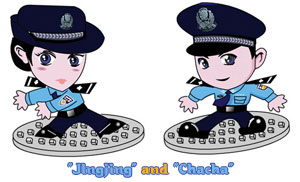
These cartoon web cops named “JIngjing” and “Chacha” (the word “jing cha” means “police” in Chinese) will apparently be patrolling websites originating in the southern Chinese city of Shenzhen. (…) According to the Public Security official interviewed by the Beijing Youth Daily, their real function is to remind internet users that the Chinese police are watching people online no differently than offline. In other words: don't do anything online that you wouldn't do in a physical public place in China!
Blogger South Puget Sound Libertarian shares his thoughts and this image of Shenzhen Internet police mascot, JingJing:

Notice that JingJing is cute. The face that the Chinese government has decided to put on its repression is not that of the Orwellian jackboot stamping on a human face forever. No, totalitarianism comes wrapped in cuteness these days. So how could you really object? After all, it’s just the government trying to protect you from evil doers on the internet.
In addition to this new technique for monitoring the Web, Beijing police are also posting signs clearly intended to intimidate Internet users at the entrances to Internet cafes (see image below):
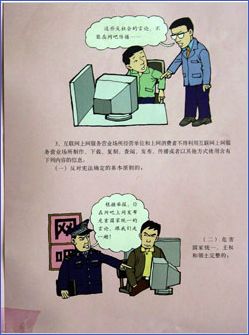
“You should not spread antisocial material on the Internet” on the top, and “Please come with me because you published materials to harm the unity of the nation” on the bottom. Photo Credit: Elizabeth Dalziel/AP via freemedia.at.
Sohu.com and Sina.com, the two leading Chinese portals where the virtual and “cute” cops will be patrolling, are already censoring their users’ content quite aggressively. Beijing-based blogger Liu Xiaoyuan is suing Sohu.com for censoring some of his blogposts. And four Chinese lawyers have protested the “un-transparent, arbitrary, and unaccountable way in which Sina.com has been censoring blog posts by bloggers on its system,” wrote Rebecca MacKinnon.






13 comments
I imagine the cartoons will only be cute the first half hour they pop up on the screen… after that it’ll be just like clippy.
Check out this link for an artist’s rendering of Clippy patrolling the Chinese internet:
http://www.itgumbo.com/mumbogumbo/2007/08/china_plans_to_monitor_web_act.php
I wonder if I can use these virtual police to launch complains against blog owners who decides to censor my comments despite being completely relevant and within the topic of discussion.
Perhaps they can help me get websites blocked on websites whose owners have violated freedom of expression of people who wish to make comments.
mahathir_fan:
I’m sure strategypage would be an amusing place for jing jing and cha cha to try their antics. Maybe if you didn’t post such stupid comments they wouldn’t get deleted.
nanhemouthfulchuan,
maybe if you have some more brain cells you would realize that they were deleted because the in topic comments were preventing the party from getting started.