
India: Introducing the Tata Nano

The unveiling of Tata Nano, a new supermini car at the New Delhi Auto Expo today has created quite a commotion on the blogosphere. The standard version of the car is 100,000 Rs (approximately 2500 USD) making it the cheapest car to hit the Indian market.
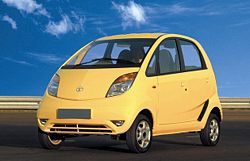
The reception to the car has been quite mixed. Some claim that such a cheap car is only going to add to the infrastructure woes in Indian cities, already weighed by congested roads. Plus, the potential of pollution increasing as more cars hit the road. However, a lot of people are extremely positive about the car.
Indian Muslims writes that the car could have an interesting impact on rural India.
I agree with the critics that at least it is going to be a traffic disaster. Our cities are already seething with jams and crowded places. But then Ratan Tata is a businessman. And his focus is on bringing products which people need at the cheapest possible price. The infrastructure problems have to be solved by our policy makers and politicians. And it may be too much to ask from them. We have seen Bangalore and Pune become pathetic without much being done to keep pace with the exploding population of these cities. I am sure if this car is a success it will be a traffic disaster. But then if we think outside our cities, in the rural areas, where 70% of India lives it could be a life changing thing.
IndieQuill sums up the range of reactions, and points out that there is no reason for cars to be a luxury good.
On the one hand, where the hell do any of us get off making the case that cars should remain a luxury? Ratan Tata might be indulging in a PR exercise but he’s got a point when he says there are tons of families out there who’re making do with extremely unsafe modes of transportation because they can’t afford safer alternatives. Anybody who’s seen a woman balance a tiny baby on her lap while clinging to her husband as they sit on his bike and make their way through bumper-to-bumper traffic has a lot of nerve arguing that that couple ought to stick with their bike so that the rest of us, with more money in our bank accounts, can swan around in our a/c cars.
Don't Trust The Indian Media! has pictures of the car from the Auto Expo and writes that activists are likely to lose goodwill if they target people for being aspirational.
About Sunita Narain and R K Pachauri's comments on congestion and pollution, while valid stink of elitism I am afraid. People will protest against this car, but they should instead go after factories, after diesel generator sets and so much more. The problem with Indian greenies is that by protesting against the wrong things, they tend to lose goodwill. Remind me to cancel my subscription to Greenpeace. Don't go after people's aspirations guys, you lose goodwill. Tell people to consume more smartly, and tell our government to spend more wisely and not allow unfettered development, but mobility and communications are the wrong things to go after.
Ultrabrown expresses some safety concerns, but appears pretty positive about a car that promises – at the very least – protection from the elements.
Tata Motors just launched the modern-day equivalent of that Corolla, a car which costs less not only after adjusting for inflation, but in simple dollars as well. The Tata Nano isn’t a beauty queen, nor does it come with a click wheel. Its bumper curlicues evoke a late-model Ford Taurus, its absurdly high brow a boxfish. But at just Rs. 1 lakh ($2,500), it could put safer transport into the hands of middle- and lower-class families across the world.
Marketing Practice looks back at the time when the car was initially announced and scoffed at, and how the car probably doesn't need any marketing to boost sales.
In the marketing front, Nano had the dream start . Infact Nano may need no ads but heavy dose of positive PR during the launch. The brand may have to counter the skepticism surrounding the performance . Another nightmare is managing the initial rush of the customers. Since this is a car for the common man, there is every possibility that the customers could be given a raw treatment at the dealership touch- points. Indian marketers are still to wake up to the possibilities of a good customer service. How Tata and its dealers handle the initial euphoria will be something to watch for in the Customer-relationship perspective .




21 comments
Having grown up in rural INDIA,and progressing from foot to cycle to bike to car,I know what it feels like to ferry ur little brother from school 10kms away in monsoon. Isnt t car a dream come true for millions. And when the car fulfils the basic emission and safety norms,what is everyone so unhappy about. Families buying it spend wisely,they have to run for 30 days. They would spend oil wisely and in fact,cause less pollution than is being feared. The congestion is due to problems in infrastructure,people can’t do much about it. Why do millions have to be left out if some driving AC sedans are crying about pollution??? In my view,hats off to TATA NANO.
I dont know whose Sunita Narain and what she said, but I am intrigued that Dr. Pachauri has no qualms with the three wheeled autorick and its pollution; nor with the highly polluting Padmini cab still running on twenty year old engines and hogging road space. Just think about it sir. If we can have Nanoes instead of the stupid ricks & cabs on city roads then a lot of traffic will ease out. Also guys on scootees overladen with wife and kids can now lead a better life. Where I live (south Mumbai), lots of people have bought cars, but they mostly take the public transport, except on special occasions. So don’t criticize the Nano, just give us better public transport, nature will take care of the rest.
This is a breakthrough of historic proportions. Mobility at this price will lift hundreds of millions from poverty. Tata’s initiative is not a polio vaccine, but for it’s gift to the poor, it is no less heroic as a breakthrough deserving a Nobel consideration. As for pollution, if moderation is enforced on the world’s wasters, perhaps the poor of the world can have an opportunity to rise. Don’t devalue a monumental achievement!
I thinks this is a remarkable achievement for the Indian Auto industry, as well as for the TATAS. congratulations! As long as the car performs well, is safe and provides a better mode of transportation to the average indian family (and others in the developing countries as well) it deserves a great deal of appreciation. Good Job TATA!!
Heh i think this vehicle is a very good idea, its what we the poor have been waiting for, too bad its in India and not in Belize… anyone interested in exporting this vehicle? Feel free to contact me…
Please reconsider marketing the Nano in the usa!!! There are millions like myself who will buy this car! What you see on tv is not representing most of America.. luxury is not that important to us!!! HONEST! Standard of living is bad and getting worse for the middle and low class citizens. 50 MILES per GAL. A car I could buy outright and not need to finance… therefore needing only basic insurance coverage… saving money there too!!! PLEASE RECONSIDER…sell me this car! Cheryl Kern
well, all who are making a cry and hue bout congestion, should consider this. With Tata rolling out nano, they have merely changed the lower bound of car price. which in ethical terms means that, more people can buy now the car, which they always admired while traveling unsafely. saying that Nano will lead to congestions is actually analogous to saying that Now [ when cars are available at 1 lakh ] only those who can pay for a car more than 2 lakhs aren’t really a possible threat to traffic problems. It’s a sheer discrimination against those who can buy a car but can’t pay more than 2 lakhs. Which in any religion is ofcourse worst possible form of discrimination. I have seen a single person riding his Ford Endeveour [ which takes 3 times the space as Nano ], similarly other big cars are no good. It’s the people who need to realize that they need to create space for the new one’s arriving instead to not allowing others to enter on roads with the only car they can afford.
Time to get rid off big monster cars & SUVs from the roads… I wish they alot one lane for the little nano and cars like this in the future….They should encourage this type of cars by giving some tax benefits and imposing more tax on the gas guzzlers… Because they don’t have any right to polute more this mother earth. May we can afford now but god knows who will afford in the long run by the skyhigh gasoline prices.
Consider this in case of the Nano. If a 100 people were to buy cars, and they brought Nano’s instead of any big cars, given its fuel consumption, the total oil consumption for this batch of buyers would be lower. Also consider this. If we take the the same emission standards, the percentage carbon emission for lower fuel consumption (liters of oil)of Nano would be lower that the guys in the bigger cars. Next consider this. These guys with 100 Nanos would occupy lesser space on the road. So what is this nonsense about ? Are you saying more people will now buy cars, and therefore more pollution and road congestion ? Its like saying more people will now eat food, therefore more rain forests will be lost. So new population should not eat food. I think cheaper transport will improve productivity of a lot of people who cannot afford BMW’s. We are making history. Please encourage it. Already the world has become smaller due to the Net. Now let productivity also get homogenised.
For the past 10 years, I have traveled to Italy and admired how people with little trouble park their tiny cars into the tightest of spaces. The new Fiat-500 (Cenquecento), design car of the year, is a completely reworked model of the original Cenquecento, the latter that put impoverished Italians in post-war Italy on the road. Italians love their little cars, as much as they are proud of their “Formula Uno Farrari”. Let’s face it the Nano is the answer to millions of Indians who want to experience car ownership for the first time. Shabaash to Tata for leading the way!